
AWS Agentic Security: How Businesses Can Secure AI Agents | TeamSource

A practical guide for enterprise IT leaders, distributors and education technology decision makers
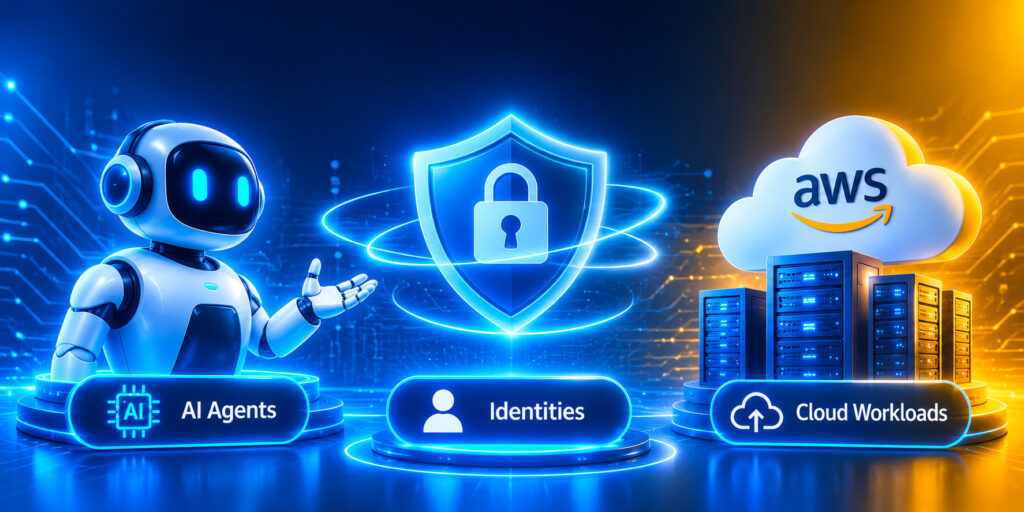
An AI assistant that summarizes a support ticket is useful. An AI agent that can also look up an employee, change access permissions or update a cloud resource has a much greater level of authority. That added capability can improve productivity, but it also creates new security responsibilities.

For CIOs, IT managers and business owners, the question is no longer simply whether AI can complete a task. It is whether the agent has the right identity, access, oversight and operating boundaries to complete that task safely.

AWS provides services and guidance for securing agentic AI workloads, including identity management, policy enforcement, data protection and observability. Organizations adopting these technologies must combine those controls with sound application security and a well managed cloud environment.


Why agentic AI security matters to your business

An AI agent interprets a request, plans steps and may use connected tools or services to carry them out. Those tools can include document repositories, databases, business applications and cloud resources. This makes an agent different from a conventional chatbot: it may not only provide information, but also initiate actions.

Consider a distribution business that wants to automate parts of its order, invoice or customer support workflow. An agent might retrieve customer information, check an order status or prepare an update in an enterprise system. If its access is too broad, a compromised instruction or mistaken decision could expose confidential records or change business data. The same concern applies to school systems handling staff or student information.

A secure deployment begins by defining the business owner and technical owner, the users allowed to interact with the agent, the data it may access, the tools it may use and which actions require human approval.

1. Give every AI agent a defined identity and permission scope
Organizations should distinguish the person requesting a task, the agent or workload executing it, and the permissions available in the destination system. An authenticated agent should not automatically inherit every permission held by a system administrator or application operator.

AWS offers services such as Amazon Bedrock AgentCore Identity for agent identity and credential management, while AWS Identity and Access Management (IAM) governs access to AWS resources. Workload roles, temporary credentials and least-privilege permissions help limit what an agent can do.

For example, an employee facing assistant may be allowed to retrieve an approved operating procedure. That does not mean it should be able to access payroll, customer financial records or another employee’s private information.
 
2. Enforce permissions outside the AI model
A system prompt can tell an agent what it should do, but it is not an authorization system. Enforce permissions in application code, APIs, gateways and destination services. AWS documents policy controls for tool requests routed through Amazon Bedrock AgentCore Gateway; teams must also secure any alternative route to the same backend.

High impact actions should have an approval step. Before an agent changes user access, modifies a production resource or sends sensitive information externally, an authorized person should review the exact target and operation. If the agent changes the request after approval, the action should be reviewed again.
 
3. Defend against prompt injection and unsafe memory
Prompt injection occurs when instructions embedded in a message, document or tool response attempt to redirect an agent. Retrieved content should be treated as untrusted input, even when it comes from a legitimate business application.

Use layered safeguards: validate inputs and tool parameters, separate system instructions from retrieved content, apply model guardrails where appropriate and enforce access permissions independently. Persistent agent memory also needs controls over what can be stored, who can retrieve it and how suspicious or inaccurate entries are handled.

4. Protect the business data agents retrieve and create
Access decisions should happen when data is retrieved, not only after the agent has already received it. Restrict each workflow to the information it needs and preserve user, department, customer and tenant boundaries.

For distributors and wholesalers, sensitive information may include customer records, pricing, invoices, supplier details and financial data. For schools, it may include staff and student related records.

Organizations should define retention rules for prompts, generated files, conversation history and agent memory, and avoid creating unnecessary copies of confidential information.
 
5. Secure the cloud and IT environment underneath the agent
Agent level safeguards depend on the security of the infrastructure hosting the application and connecting its tools.

Separate development and production environments, isolate sensitive workloads, review network and outbound access, protect administrative access, and keep code, dependencies and runtime images maintained.

Treat every new tool connection as a security change: it may expand the systems and data an agent can reach. Use controlled deployment processes, version control and documented reviews for changes to agent code, tool definitions and security policies.
 
6. Monitor agent activity and prepare to stop it.
Organizations need an audit trail connecting the initiating user, agent identity, requested tool action, authorization decision and resulting change. AWS services such as Amazon Bedrock AgentCore Observability and Amazon CloudWatch can support monitoring and tracing when configured for the workload.
 
Define alerts for unusual tool use, repeated access denials and unexpected activity. Assign incident response ownership and test how to pause an agent, disable a connection, revoke or rotate credentials and restore normal operations. A manual fallback is important for business critical processes.
 
Where TeamSource Technologies fit secure AI adoption is not only a model selection exercise. It depends on the wider IT environment: identity and access management, cloud and infrastructure architecture, cybersecurity controls, system integration, monitoring and user readiness.
 
TeamSource Technologies works across enterprise technology areas including cybersecurity, cloud and virtualization, infrastructure and business solutions. These capabilities are relevant foundations for organizations reviewing how AI enabled workflows connect to their existing systems.
 
TeamSource can help businesses assess their IT environment, identify security and infrastructure requirements, and plan the controls needed for a more reliable technology operation.

For a distributor managing invoices, inventory and customer records, this may mean reviewing who can access each system, how business applications are connected and whether sensitive data is adequately protected.

For an education provider, it may mean strengthening infrastructure and access boundaries around systems that hold staff or student information.
The appropriate scope depends on the organization’s architecture and requirements.

AWS specific implementation, AgentCore configuration or managed AI agent security should be presented as a TeamSource service only after the relevant technical capability and delivery scope have been confirmed.

Plan a more secure technology environment with TeamSource

As AI becomes more connected to everyday business operations, organizations need technology environments that are secure, manageable and ready to scale.

TeamSource Technologies can support the wider conversation around cybersecurity, cloud, virtualization and enterprise IT requirements.

Speak with TeamSource Technologies to review your current IT environment, identify infrastructure and security priorities, and plan the next steps towards responsible AI adoption.

Frequently asked questions

What is AWS agentic security?

It is the practice of protecting AI agents and the identities, tools, data and cloud resources they use on AWS. It combines cloud and application security with controls for model-driven decisions and actions.

How are AgentCore Identity and IAM different?

AgentCore Identity provides agent-oriented identity and credential capabilities. IAM governs permissions to AWS resources through policies and roles. Both must align with the destination system’s authorization requirements.

Can Amazon Bedrock Guardrails replace tool authorization?

No. Guardrails can help filter certain unsafe inputs and outputs, but independent authorization controls must decide whether a requested operation and resource access are permitted.

Why do distributors need to consider agent security?

AI agents connected to invoicing, inventory, customer or supplier systems may handle commercially sensitive data or initiate operational changes. Access boundaries, approvals and monitoring help reduce the impact of mistakes or misuse.

How should schools begin using AI agents securely?

Start with a narrow staff workflow using approved data and limited permissions. Define ownership, preserve user access boundaries, require review for high-impact actions and test how to stop the agent before expanding its authority.

Leave a Reply

Your email address will not be published. Required fields are marked *