

Why Digital Transformation Matters to Businesses.
How businesses of every size can use technology from AI to connected operations to improve performance and adapt with purpose.

Digital transformation is not simply a technology upgrade. It is a business strategy for improving how an organization serves customers, supports employees, and delivers its products or services.
For business owners, understanding digital transformation helps clarify where technology can create value, which changes to prioritize, and how to prepare the organization to adopt them.
This matters to medium sized businesses as much as to large enterprises. A medium sized company may need to focus investment on a few high impact improvements.
A larger organization may need to coordinate change across teams, systems, and locations. In both cases, the goal is not to adopt every new tool, but to connect technology to measurable business needs.
Customer expectations, business processes, and available technologies continue to evolve. Organizations that understand their current capabilities and plan for change are better positioned to improve how they operate and respond to new needs.
Digital transformation can help businesses streamline work, connect information, improve customer experiences, and make more informed decisions.
The starting point should be a business challenge not a product demonstration. Identify what needs to work better, understand the current process, and define an outcome that can be measured. This keeps technology investment focused on business performance rather than novelty.
The opportunities and responsibilities vary by sector, but each organization benefits from aligning its technology choices with its work and goals.
The opportunities and responsibilities vary by sector, but each organization benefits from aligning its technology choices with its work and goals.
SaaS businesses adopting AI may use AI solutions to improve products, customer support, or internal workflows. Successful adoption requires more than selecting a tool: leaders should consider how it fits existing systems, what data it uses, who reviews its outputs, and how its value will be measured. AI can support a transformation strategy, but it does not replace one.
Banks and financial services organizations may use digital initiatives to improve customer-facing services and internal processes. These efforts should be planned with attention to security, governance, customer trust, and regulatory responsibilities.
Schools and universities can use digital tools to support learning, communication, access to services, and administrative work. The aim is to improve the experience for students, educators, and staff—not to digitize activities without a clear purpose.
Manufacturing and logistics businesses may focus on connecting information across production, inventory, and delivery. Better-coordinated processes can help teams understand operations and identify where attention is needed. Any solution should fit the realities of equipment, facilities, and supply chains.
These examples are starting points, not a universal checklist. Each organization should assess its own customers, operations, risks, and digital maturity before setting priorities.
AI adoption needs a clear business purpose
AI is attracting attention across industries, but adopting a tool is not the same as transforming a business. Before introducing an AI solution, define the task or decision it should improve. Consider the data it will use, how people will review its outputs, what risks need to be managed, and which measures will show whether it is working.
This approach allows organizations to explore AI opportunities while keeping accountability, processes, and business outcomes in view.
Build a practical transformation plan
A strong plan connects long-term direction to achievable steps. It should include:
- An assessment of the organization’s current digital capabilities and needs.
- A clear vision, with prioritized goals and expected outcomes.
- A phased plan for implementation and scaling.
- The people, budget, executive support, and infrastructure required.
- Defined ownership, reporting, and timelines.
- Relevant KPIs to track progress and guide decisions.
Medium-sized businesses may start with one high-value improvement and expand based on results. Larger organizations may need additional coordination and governance to align teams and systems. Neither approach requires a disruptive, organization-wide rollout from day one.
Make change sustainable
Technology creates value when people can use it effectively and when it is supported by reliable processes. Four foundations help make transformation sustainable:
- Governance establishes accountability and helps manage risk.
- Training builds the skills and confidence people need to adopt new ways of working.
- Processes make improvements consistent and repeatable.
- Measurement shows whether the changes are producing the intended results.
Digital transformation is an ongoing capability, not a one-time project. Organizations can learn from each phase, adjust their approach, and scale the changes that deliver meaningful results.
Practical support for your transformation
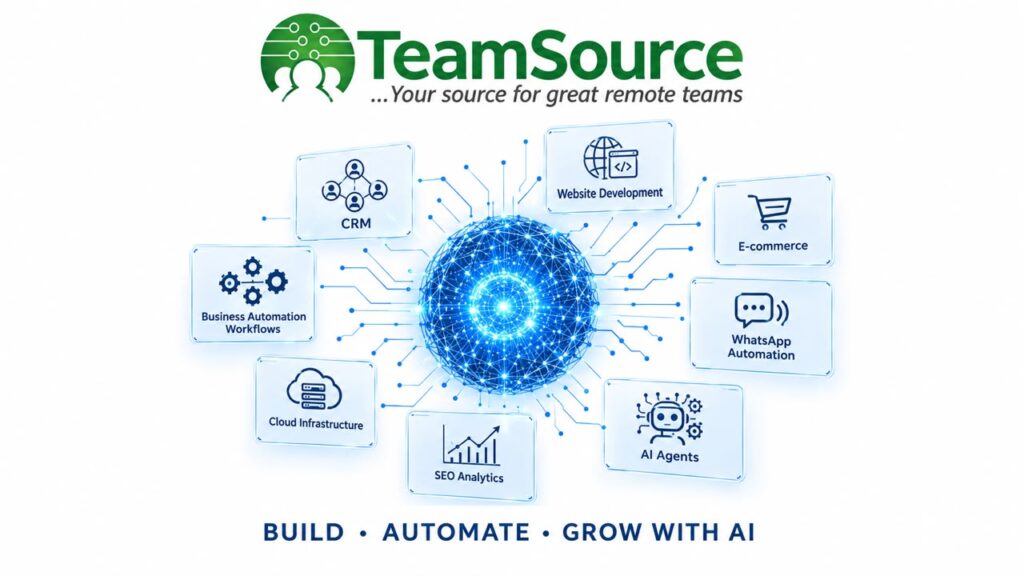
Putting a transformation strategy into practice may involve changes to systems, workflows, security, and the employee experience. TeamSource Technologies supports organizations with business process automation, cloud and Microsoft infrastructure, cybersecurity and risk assessment, digital workplace transformation, and scalable IT systems.
The right mix depends on your goals, current digital maturity, and capacity for change. To explore practical next steps, book a consultation with TeamSource.